Why Did My Organic Traffic Drop? Diagnose the Cause Before You Fix It
Organic traffic dropped? Use clicks, impressions, rankings, timing and affected pages to narrow the cause before making changes that could backfire.
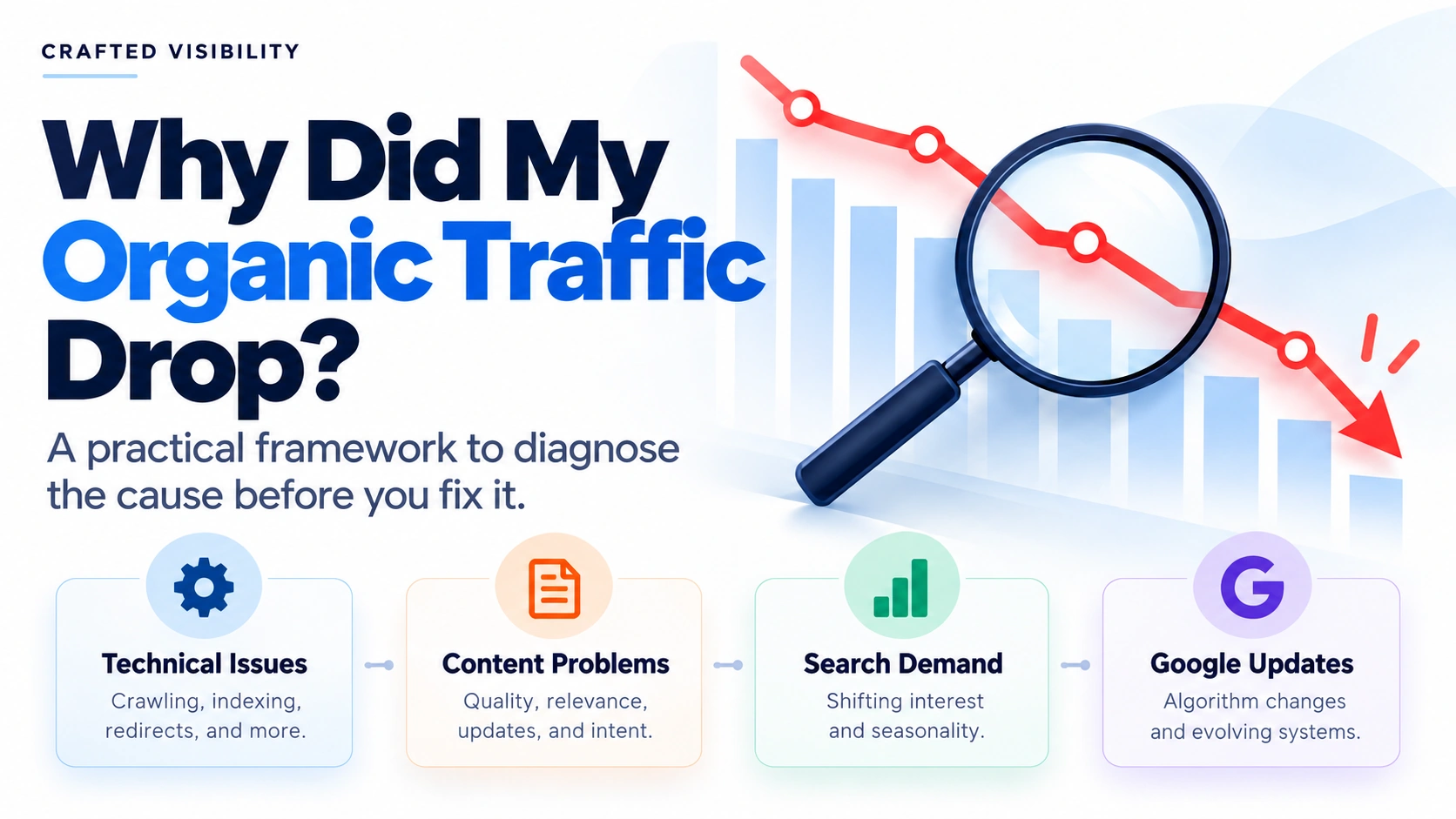
An organic traffic drop tells you that something changed. It does not tell you what changed.
That distinction matters because very different problems can produce a similar-looking downward graph. A site can lose clicks because rankings fell, search demand weakened, Google stopped indexing important pages, a migration introduced technical problems, the search results changed, or users started clicking different results. Sometimes the apparent decline is partly a reporting issue rather than a search-performance problem.
Google’s guidance on debugging Search traffic drops lists algorithmic changes, technical issues, security or spam issues, seasonality, changing interests and site moves among the areas worth investigating when organic Search traffic falls.
The useful question is therefore not:
“What SEO fix should I make?”
It is:
“What changed in the data, how much of the site was affected, and what should I investigate next?”
That is the basis of the Crafted Visibility Traffic-Drop Triage:
METRIC PATTERN × AFFECTED SCOPE → NEXT INVESTIGATION
This is a Crafted Visibility diagnostic methodology, not a Google framework. Its purpose is to reduce guesswork before you start changing pages that may not actually be the problem.
Start with the pattern, not the suspected cause
One of the easiest mistakes after an organic traffic decline is to begin with a theory.
Traffic falls during a Google update, so the update must be responsible.
A developer deployed a change last week, so the release must have caused it.
A competitor published new content, so they must have taken the rankings.
Any of those explanations could eventually prove relevant. None should be treated as the diagnosis before you examine the evidence.
Google’s traffic-drop guidance reflects the same practical reality: several different situations can reduce organic Search traffic, so the first task is to establish which pattern actually occurred.
Before changing content, deleting pages or rebuilding templates, establish three things:
- When did the decline begin?
- How much of the site was affected?
- Which Search Console metrics changed?
Those answers determine the next useful investigation.
First confirm the drop is real
Before diagnosing SEO, confirm that you are looking at a genuine organic Search decline.
Isolate Google organic performance
A fall in total website traffic is not automatically an SEO problem.
Paid campaigns may have stopped. Referral traffic may have disappeared. Direct traffic can change. Analytics configuration can break. Social traffic can rise or fall independently of Google Search.
Start with Google Search Console because it measures performance in Google Search itself.
The Search Console Performance report provides four core metrics:
- Clicks: how many times users clicked your site from Google Search results.
- Impressions: how many times your site appeared in Search results.
- CTR: clicks divided by impressions.
- Average position: the average position of the topmost result from your site for the relevant grouping.
It can then break performance down by queries, pages, countries, devices, search appearance and dates.
Those dimensions become much more useful than one sitewide traffic number once you start diagnosing a decline.
Compare equivalent periods
A graph can look alarming simply because the comparison is poor.
Compare the affected period with:
- the preceding equivalent period;
- the same period last year where seasonality is plausible;
- a sufficiently long window to see what happened before the decline.
Google recommends extending the Search Console date range and comparing periods to determine whether the change is seasonal and whether particular queries, URLs, countries, devices or search appearances account for the loss.
Avoid drawing conclusions from a single bad day when the business normally experiences day-of-week, holiday or seasonal variation.
Check whether the newest data is still settling
Recent Search Console data can be preliminary. Chart and table totals can also differ depending on how the data is grouped and aggregated.
That does not mean you should distrust Search Console. It means you should avoid diagnosing a major SEO problem from an incomplete final data point.
Google also recommends checking its Search Console Data Anomalies information when investigating an unexpected decline, because some unusual movements can relate to changes in data processing or logging rather than the site’s search performance.
Cross-check another analytics source when necessary
If Search Console suggests a significant Search decline but your analytics platform tells a very different story, investigate the measurement setup before assuming either chart represents the whole truth.
Ahrefs’ sudden-traffic-drop diagnostic guide recommends checking analytics data alongside Search Console and looking for a consistent downward pattern rather than expecting the platforms to report identical numbers.
The objective at this stage is simple:
Confirm that Google organic performance actually declined before diagnosing why.
Pin down exactly when the decline started
Once the decline is confirmed, timing becomes useful evidence.
Not proof. Evidence.
Sudden drops and gradual declines point to different investigations
A near-vertical fall over a short period deserves a different first investigation from a slow decline over six months.
A sudden loss can justify checking for:
- server or availability problems;
- accidental
noindexdirectives; - robots.txt changes;
- redirect mistakes;
- migration problems;
- major template changes;
- security or manual-action issues;
- an unusually large ranking movement.
A gradual decline may make you look more closely at:
- changing search demand;
- slowly weakening rankings;
- search-intent changes;
- competitors improving;
- content becoming less useful;
- SERP changes;
- important pages losing visibility over time.
These are investigation directions, not one-to-one causal rules.
Compare the date with your own change history
Before blaming an external algorithm change, check what happened on your site.
Look at:
- CMS or platform releases;
- redesigns;
- migrations;
- redirect deployments;
- navigation changes;
- internal-link changes;
- canonical changes;
- robots or indexing directives;
- major content rewrites;
- deleted or consolidated pages.
Ahrefs’ diagnostic process distinguishes between planned and unplanned technical changes when investigating a traffic decline.
Crafted Visibility view: a coinciding Google update should be treated as one line of investigation alongside evidence from your own change history, rather than being assumed to outrank that evidence automatically.
Check confirmed Google update timing
If the dates overlap with a suspected Google update, verify that the update actually occurred.
Use Google’s Search Status Dashboard rather than relying on social posts, screenshots or speculation.
For example, Google’s September 2026 spam update incident record shows that the update was released on 24 September 2026, applies globally and to all languages, and the rollout was completed on 8 October 2026.
That tells you an update was underway during that period.
It does not prove that the update caused a particular site’s decline.
Use update timing to open an investigation branch, not close the diagnosis.
Classify how much of the site was affected
The next question is not merely “Did traffic fall?”
Ask:
Where did it fall?
Google recommends reviewing affected pages to determine whether a decline occurred across the whole site, a group of pages or one particularly important page.
That distinction can radically change the investigation.
Sitewide decline
If most directories, templates and major page types decline together, investigate issues capable of affecting a large portion of the website.
Examples include:
- broad crawl or indexing problems;
- sitewide technical changes;
- migrations;
- major changes in search demand;
- significant ranking-system effects;
- widespread quality or relevance problems.
A sitewide decline does not prove a sitewide cause, but it makes a one-page explanation less convincing.
Section or template decline
Suppose product pages fall but editorial articles remain stable.
Or service pages decline while the blog grows.
Or one international directory loses impressions while the rest of the site remains unchanged.
That pattern should focus the investigation on what those URLs share:
- template;
- internal linking;
- intent;
- content type;
- canonical setup;
- indexability;
- search demand;
- commercial purpose.
Semrush’s website-audit guidance similarly recommends scoping an investigation around the actual problem, with larger sites often requiring a focused review of affected pages or sections rather than an indiscriminate audit of every URL.
A small group of URLs
When most of the site is healthy but five important pages account for the loss, diagnose those pages first.
Do not bury the useful signal inside sitewide averages.
One important page
Sometimes the apparent sitewide traffic problem is really the loss of one page that previously generated a large share of organic clicks.
Compare page-level click differences rather than assuming every URL contributed equally.
This is also where business context matters. Losing 1,000 low-intent informational visits is not necessarily the same commercial problem as losing 100 visits to a high-intent service page.
Search Engine Land’s analysis of early SEO warning signs illustrates how aggregate traffic can hide losses on commercially important queries or landing pages, including a hypothetical example where Google alternates between URLs while the headline position remains relatively stable.
As a site’s page types and search journeys become more varied, aggregate traffic alone tells you less about where the actual problem sits.
Read the Search Console metric pattern
Once timing and scope are clear, examine what changed in Search Console.
This is where the Crafted Visibility diagnostic matrix becomes useful.
Crafted Visibility traffic-drop pattern matrix
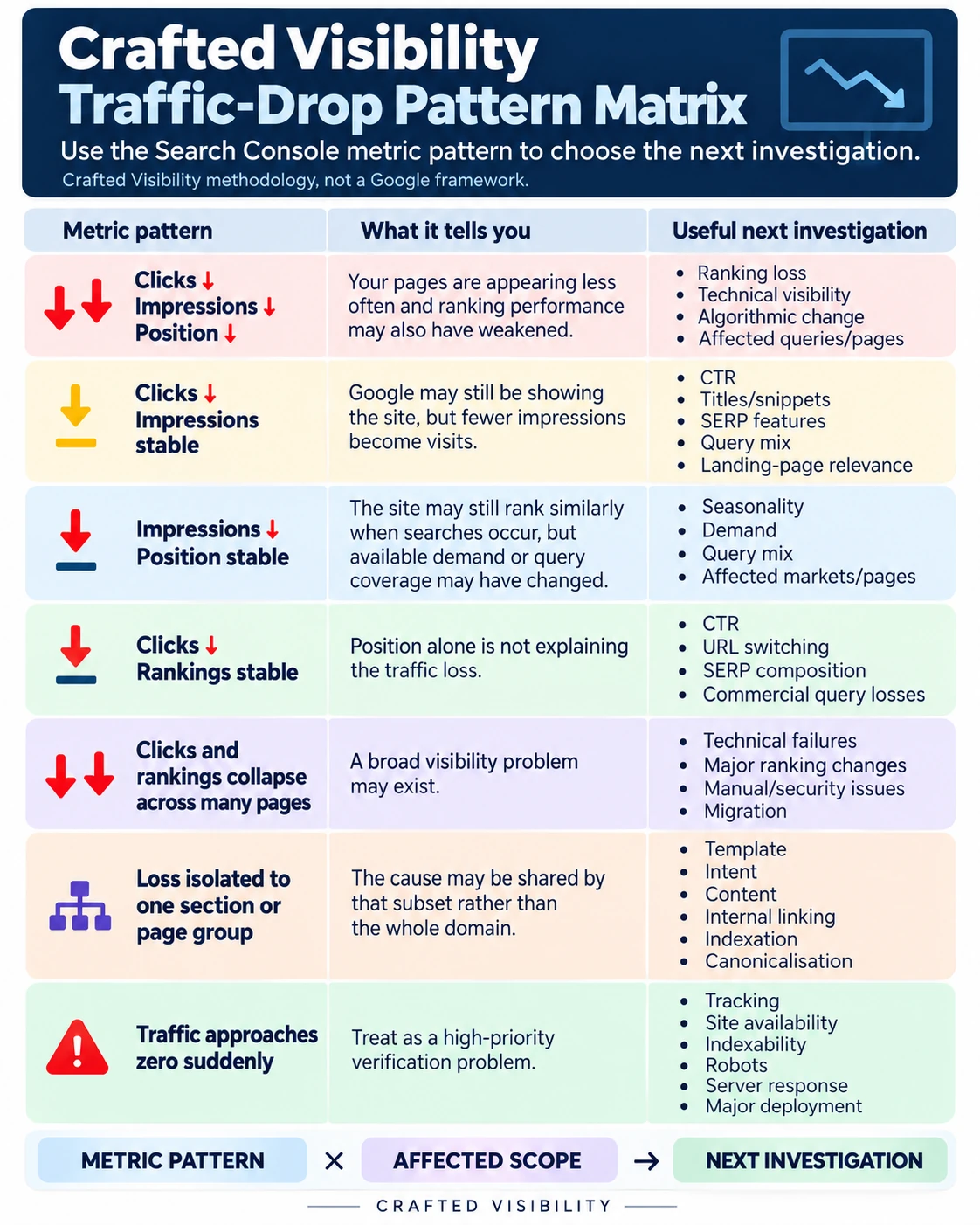
| Metric pattern | What it tells you | Useful next investigation |
|---|---|---|
| Clicks ↓ + Impressions ↓ + Position ↓ | Your pages are appearing less often and ranking performance may also have weakened | Ranking loss, technical visibility, algorithmic change, affected queries/pages |
| Clicks ↓ + Impressions roughly stable | Google may still be showing the site, but fewer impressions become visits | CTR, titles/snippets, SERP features, query mix, landing-page relevance |
| Impressions ↓ + Position broadly stable | The site may still rank similarly when searches occur, but available demand or query coverage may have changed | Seasonality, demand, query mix, affected markets/pages |
| Clicks ↓ + Rankings broadly stable | Position alone is not explaining the traffic loss | CTR, URL switching, SERP composition, commercial query losses |
| Clicks and rankings collapse across many pages | A broad visibility problem may exist | Technical failures, major ranking changes, manual/security issues, migration |
| Loss isolated to one section or page group | The cause may be shared by that subset rather than the whole domain | Template, intent, content, internal linking, indexation, canonicalisation |
| Traffic approaches zero suddenly | Treat as a high-priority verification problem | Tracking, site availability, indexability, robots, server response, major deployment |
The matrix does not tell you the cause automatically.
It tells you which branch deserves investigation next.
Clicks and impressions both fell
If clicks and impressions fall together, the site is generally appearing less often for the affected searches.
Possible questions include:
- Did rankings fall?
- Did important pages stop being indexed?
- Did search demand decline?
- Did a migration change URLs?
- Did the query mix change?
- Is the loss sitewide or concentrated?
Impressions remain stable but clicks fall
This is a different problem.
Your pages may still be visible, yet fewer searchers are choosing them.
Google notes that stable impressions combined with falling clicks can warrant reviewing titles and snippets and considering whether other search-result presentations are attracting the click.
Also examine:
- CTR by query;
- CTR by page;
- changes in search appearance;
- the types of results surrounding your listing;
- whether Google is showing a different page from your site;
- whether the remaining impressions come from less commercially useful searches.
Do not rewrite every title merely because sitewide CTR changed. Find the queries and pages responsible first.
Impressions fall while position looks stable
This pattern can occur when demand changes rather than rankings.
Google recommends investigating changing interests and seasonality by examining queries that lost clicks and impressions and comparing broader search interest.
But be careful with average position.
Search Console’s average position is an aggregated metric, and its meaning changes according to the grouping being viewed.
A stable sitewide average can hide large movements underneath.
Rankings appear stable but traffic falls
This is another reason not to rely on one metric.
Search Engine Land’s hypothetical example shows how a stable-looking average can coexist with changes in which URL ranks, while headline traffic can conceal weaker performance on commercially important pages.
Ask:
- Is the same URL still ranking?
- Are high-intent queries slipping while informational visibility grows?
- Has traffic shifted to less valuable landing pages?
- Is Google alternating between pages whose roles overlap?
If URL switching reveals genuine intent overlap between your own pages, investigate whether there is a real keyword cannibalisation conflict rather than treating the headline position as stable.
Rule out hard technical failures before rewriting content
If the decline is abrupt or unusually broad, technical verification should happen before a large-scale content rewrite.
Google identifies technical errors as one major category of organic traffic loss, including problems that prevent pages from being crawled, indexed or served. Some technical problems can be sitewide while others affect specific pages.
Check the systems that control whether important URLs remain accessible and indexable.
Crawl and server access
Look for:
- server downtime;
- abnormal error responses;
- robots.txt mistakes;
- unexpected crawling changes.
Indexability
Check whether important URLs acquired:
noindex;- incorrect redirects;
- conflicting canonical signals;
- unexpected removals;
- other directives that prevent the intended page from being indexed.
Migrations and URL changes
URL changes can create ranking fluctuations while Google recrawls and reindexes the site.
Audit:
- redirects;
- destination URLs;
- canonicals;
- internal links;
- sitemaps;
- old URLs still receiving links or traffic.
Templates and deployments
If one page type declined, compare affected and unaffected templates.
A technically healthy homepage does not prove that a product, category, service or JavaScript-rendered template is healthy.
When the evidence points to crawling, rendering, indexation, canonicals, redirects or migration problems, the investigation has moved beyond generic traffic analysis into technical SEO diagnosis.
The important sequencing rule is:
Verify hard failures before rewriting content that may already be doing its job.
Did the drop happen during a Google update?
A Google update can be relevant without being the diagnosis.
Use three checks.
1. Did a confirmed update actually overlap the decline?
Check Google’s Search Status Dashboard.
Do not rely on “SERPs feel volatile today” as evidence that a confirmed update occurred.
2. Does the affected scope make sense?
If only one template broke immediately after a deployment while the rest of the site remained stable, your own technical change may deserve investigation before an unrelated sitewide algorithm theory.
If a large set of previously strong pages loses rankings across many related queries during a confirmed ranking update, the update becomes a more relevant line of investigation.
Still not proof.
3. What happened to rankings and pages?
Google distinguishes between small and large position drops.
In the case of a small position drop, Google advises against making radical changes when a page is already performing well because ordinary ranking fluctuations can reverse without intervention.
A large, persistent position drop deserves a different response. Google recommends self-assessing the website more broadly to check whether the content remains helpful, reliable and people-first rather than assuming nothing can be done.
That is very different from reacting to an update headline by rewriting the entire site.
A better principle is:
Update timing is context, not diagnosis.
When the problem is search demand, SERP behaviour or competition
Not every traffic loss originates on your website.
Search demand can fall
Interest in a product, service or topic changes.
Seasonality can also create predictable drops even when rankings remain reasonably stable.
Google recommends comparing affected queries with broader search-interest patterns to determine whether demand fell only for your site or more widely.
Compare equivalent seasonal periods before treating recurring demand cycles as an SEO failure.
The search results themselves can change
A ranking position does not operate in isolation.
The result page can gain:
- richer search features;
- different result types;
- stronger competitor snippets;
- new search experiences;
- different intent mixes.
If impressions remain available but clicks decline, examine the live SERP for the affected query set rather than assuming the page itself suddenly became worse.
Competitors can take visibility
Competitor improvements are another investigation branch, especially when your losing queries correspond with another domain’s gains.
The goal is not to imitate whichever page moved above you.
Ask what changed in the searcher’s available options:
- clearer intent match?
- better product or service fit?
- stronger evidence?
- more useful content?
- fresher information?
- better page experience?
- stronger brand preference?
Then decide whether your page genuinely needs improvement.
When the problem is the content or page portfolio
If technical access remains healthy and demand has not obviously collapsed, move deeper into content and page ownership.
Content relevance may have weakened
A page can continue to be technically indexable while becoming less competitive for the search it previously served.
Review whether the page still:
- answers the current intent;
- covers the decision the searcher is trying to make;
- contains outdated information;
- provides enough evidence;
- matches the business’s current offering;
- deserves to remain the primary page for that query family.
This is where on-page and content SEO becomes relevant: the problem is no longer whether Google can access the page, but whether the page remains the right asset for the search.
Search intent may have changed
Sometimes Google begins rewarding a different type of result.
A query that previously favoured educational guides might become more commercial.
A broad comparison may start favouring product or category pages.
An informational phrase may develop stronger local intent.
Do not force the old page to rank for an intent it no longer satisfies naturally.
The Crafted Visibility Traffic-Drop Triage
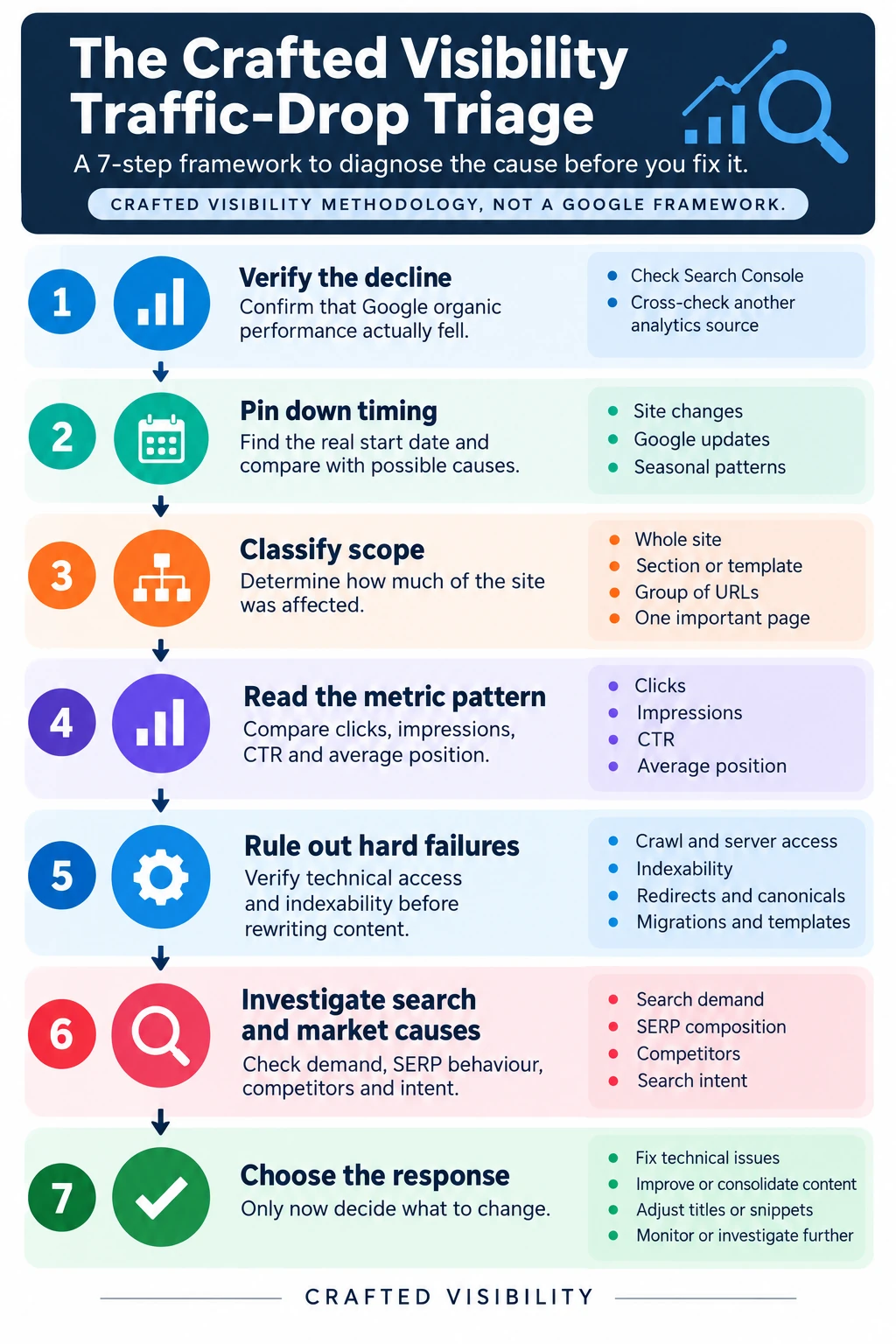
The diagnostic process can now be reduced to seven stages.
1. Verify the decline
Confirm that Google organic performance actually fell.
Check Search Console and, where useful, another analytics source.
2. Pin down timing
Find the real start date.
Compare it with:
- site changes;
- migrations;
- deployments;
- confirmed Google updates;
- recurring seasonal patterns.
3. Classify scope
Determine whether the decline affects:
- the whole site;
- one directory;
- one template;
- a group of URLs;
- one important page.
4. Read the metric pattern
Compare:
- clicks;
- impressions;
- CTR;
- average position;
- queries;
- pages.
Do not diagnose from one metric alone.
5. Rule out hard failures
Verify:
- crawl access;
- indexability;
- server health;
- directives;
- redirects;
- canonicals;
- migration implementation;
- security or manual-action issues where relevant.
6. Investigate search and market causes
Check:
- demand;
- seasonality;
- SERP composition;
- competitors;
- query mix;
- search intent;
- content relevance;
- page ownership and cannibalisation.
7. Choose the response
Only now decide what to change.
The response might be:
- fixing a technical failure;
- correcting measurement;
- repairing migration signals;
- improving or consolidating content;
- clarifying page ownership;
- adjusting titles or snippets;
- monitoring temporary volatility;
- accepting genuine demand decline;
- conducting a deeper cross-system audit.
The most important part of this framework is not the number of steps.
It is the order.
Classification comes before correction.
Choose the response only after the diagnosis
A traffic decline naturally creates pressure to “do something”.
That pressure can lead to damaging changes.
Rewriting content cannot repair an accidental noindex.
Technical fixes cannot reverse seasonal demand.
Changing titles will not solve a sitewide indexing problem.
Publishing more articles will not clarify two existing pages competing for the same intent.
Waiting for an algorithm update to pass will not repair a broken migration.
The response should match the evidence.
Sometimes the evidence supports an immediate fix. Sometimes it supports deeper investigation or monitoring before a major change.
SEO diagnosis is therefore partly about identifying what not to change — and, when the evidence does support action, changing the right thing.
When a wider SEO audit makes sense
Some declines do not resolve into one clean cause.
You may find:
- important pages losing rankings;
- indexing inconsistencies;
- overlapping content;
- weak internal linking;
- a recent migration;
- declining non-brand demand;
- changing SERPs;
- conflicting analytics signals.
At that point, examining each symptom independently can miss the relationship between them.
A broader SEO audit and strategy review can help connect technical, content, architecture and search-demand evidence into one prioritised investigation.
The objective should not be to produce the longest possible issue list.
It should be to answer four questions:
What changed?
Where did it change?
What evidence best explains it?
What should be investigated or changed next?
An organic traffic drop is a symptom. Treating the first plausible explanation as the cause can waste time and create new problems.
Verify the decline, pin down the timing, classify the affected scope and read the metric pattern before choosing the fix.
That gives you a much better starting point than reacting to the graph alone.